How to Become an AI-First Company: a 5-Step Framework

Kaiyan Ali
Founder at Montaj Digital

Kaiyan Ali
Founder at Montaj Digital
I'm Kaiyan, founder of Montaj Digital. I help professional service firms put AI and automation to work, so their people spend less time on admin and more on the work only humans can do. I've trained 250+ professionals at our AI Week, and I'm on a mission to help a million service firms do the same.
Follow me for more contentThis was the fifth and final session of our AI Week, and I put it at the end on purpose. The earlier sessions covered the categories of AI tools and how to map your workflows; this one is where all of that turns into a way of running a company rather than a pile of clever tricks.
Most business owners think they have an AI strategy. They don't. They have a few people using ChatGPT when it occurs to them, random tool subscriptions that don't really talk to each other, and a load of scattered experiments with no way of tracking whether any of them work. No shared standards, no ownership, nothing measured, and no clear road map. By the end of this piece you'll know the principles that turn that into an actual AI-first way of working. If you'd rather watch than read, the full session is embedded further down.
Most businesses think they have an AI strategy
Let me start with the uncomfortable bit, because it's where most rooms I speak to actually are. You use AI, but you don't have a strategy around it. A few people are on ChatGPT. There are a handful of subscriptions nobody can quite account for. Different people are doing different things and expecting everyone else to understand what they're working on. Nothing is measured, so nobody can say what success even looks like: is it time saved, money saved, money made? And there's no road map, so there's nothing to check progress against.
None of that means AI isn't working for you. It means it's working by accident, in pockets, and it stops the moment the person doing it gets busy or leaves. The rest of this piece is about turning those pockets into something that compounds.
AI-using vs AI-first: the difference that matters
There are AI-using companies and there are AI-first companies, and the gap between them isn't the tools. Everyone has access to the same models.
An AI-using company uses AI when it remembers. Someone logs on to ChatGPT if it crosses their mind. The team is scattered across tools, some on ChatGPT, some on Claude, some on Gemini, which is fine if each one is doing a defined job, but usually nobody can say what job. The real problem is that the knowledge lives in personal chats. Nothing is shared across the organisation, so there's no shared IP and no shared knowledge, which means there's barely a use case at all. Outputs vary from person to person, and there's no shared measurement and no clear ownership over any of it.
An AI-first company is the mindset I want you to leave with. Every tool has a clear job, a clear owner and a clear success metric. And the knowledge is packaged for reuse. That last part matters more than it sounds. Right now a lot of people would argue Claude is the best tool out there. One day it's ChatGPT, the next it might be Gemini, the next something that doesn't exist yet. If your knowledge is packaged properly, you can plug it in and out of whichever tool is king at the time, so everything still speaks to each other.
The difference that matters
AI-using vs AI-first.
AI-using
Bolted on, ad hoc.
- AI used only when someone remembers
- Team scattered across tools with no defined job
- Knowledge trapped in personal chats
- Outputs vary person to person
- No clear owner
- Nothing measured
AI-first
Built in, with a job to do.
- Every tool has a clear job
- Every tool has an owner
- Every tool has a success metric
- Knowledge packaged for reuse: plugs into any model
- Improvement measured against a road map
Two more things separate the two. Your team has to know when to use AI and, maybe more importantly, when not to, which is the whole point of mapping your workflows. And improvement has to be measured. No sensible business sets a KPI and just hopes to hit it; they set clear steps and then track it, weekly or quarterly. Give your roll-out a road map, then review it, and if you're off track, that's fine, you course-correct.
Why it pays off: more revenue from the same team
Here's why this is worth the effort. AI-first companies are delivering around five times the productivity of everyone else. The businesses integrating AI properly get two to five times the revenue per head from the same team, the same capacity, the same output, however you measure it. But only the ones with proper systems in place get there.
I want to be clear about what that doesn't mean. It doesn't mean firing people. If your first instinct with AI is to cut the team, you have probably got the wrong person in the role in the first place. The move is to build the systems, processes and infrastructure that amplify the people you have.
Take the classic marketing agency pod: a manager, an account manager who handles the clients, a designer making the assets, and a media buyer running the technical side of the paid ads. A pod like that can service around twenty clients. Hit twenty-one, twenty-two, twenty-three, and you're stuck between two bad options. Hire, and destroy your margins. Or work the team to the bare bones, watch client results drop and the team burn out, and lose the clients anyway, back down to twenty.
Amplify, don't replace
The same pod, amplified.
Standard pod
~20 clients- Manager
- Account manager
- Designer
- Media buyer
Amplified pod
3-5× the clients- Manager+ AI agent · tools · processes
- Account manager+ AI agent · tools · processes
- Designer+ AI agent · tools · processes
- Media buyer+ AI agent · tools · processes
The outcome
Two to five times the revenue per head, from the same team.
Now amplify each role. Give the account manager, the designer and the media buyer their own set of tools, processes and integrations behind them, what I loosely call an AI agent for each seat. The same pod carries three to five times the capacity while the work and the margins actually improve. On the unamplified side, the account manager is chasing the same messages over and over and reporting by hand, the designer is briefing themselves and waiting on feedback, and the media buyer is logging into every account manually to shift numbers from one place to another. On the amplified side, systems and automation carry that load so the people can do the work only people can do.
The five steps to becoming AI-first
So what are the five steps? There are more substeps under each, but these are the ones that matter.
- Strategy. Where is the business actually losing money and time?
- Workflows. Which tasks can run themselves, which need a human co-pilot, and which stay fully human?
- Tools. Hire a tool for a specific job rather than collecting them.
- Knowledge. Package what you know so any model can read it, and you're never a slave to one platform.
- Adoption. Get the team actually using it, which is where most businesses fall over.
The order matters. Skip to buying tools before you have a strategy and you'll end up with subscriptions you never open.
Step 1: Strategy, find where the business is leaking
Without a strategy you have nothing, because AI only compounds when it's embedded in your workflows rather than bolted on the side.
An AI-first company doesn't open with "what can we automate". It opens with where it hurts. Where are we losing margin? Where are we wasting skilled time, what are our best people doing every day that they shouldn't be? Where is quality inconsistent? Where do we keep hitting a growth bottleneck, is it lead acquisition, the number of clients we can handle, or chasing invoices so slowly that we always have a cash-flow problem? And where are customers left waiting, does onboarding drag because it's all manual? Answer those and you have your AI business case: not "we should use more AI", but a specific, costed leak. Start with the problem, not the tool.
"You can't just stick AI into a business without really understanding the challenges, the processes, and everything else. His frameworks are really useful and really applicable to any business." (Paz B, Kickass Online, AI Week)
Step 2: Workflows, cruise, co-pilot or human
We spent a full hour on this earlier in the week, so here I'll keep it tight. Once you know where the money is going, look at the actual work and decide how each task should be handled.
Three modes of using AI
The flight deck.
Software runs it
Low/zero variance, same process every time (e.g. transcript → action list).
AI drafts, human reviews
Valuable, nuanced work that improves through iteration (e.g. a client growth strategy).
Human only
High stakes: pricing, scoping, negotiating, legal or financial claims.
Flight-deck check
- 1How long by hand?
- 2How likely is AI to nail it?
- 3How long to brief, review & fix?
Here's what most people's work actually looks like: a client signs, and then a messy process kicks in that nobody can quite describe. One client gets onboarded in four days, the next takes eighteen, the next eleven, because there's no agreed step-by-step way of getting from A to B. Map it, and you get a consistent output every time. One rule holds all of this together: you can't add AI to a process you don't understand, haven't written down in clear steps, and haven't proven works in the real world. There's a whole session on this, how to map your AI and automation workflows.
Step 3: Tools, hire them, don't collect them
Only now do we talk about tools, and there are thousands of them. Plenty do near-identical things; plenty have a very specific use. The mindset is everything here. Don't collect tools. This isn't Pokémon, you aren't trying to catch them all. You hire them for specific jobs, and every tool needs a clear job in your toolbox. If you can't name the job the tool does, who owns it, the outcome it should produce and what success looks like once it's in, you shouldn't be bringing it in at all.
In our first session I split the field into six categories, with examples that are illustrative rather than a best-of list:
- Everyday AI: ChatGPT, Claude, Gemini, for your day-to-day work.
- Search and synthesise: Perplexity, NotebookLM, Poppy, for pulling many sources together into one answer.
- Creative tools: for building animations, designs and apps, or getting concepts and briefs out of your head so your designers can run with them.
- Autonomous agents: Manus or Claude Code, which do tasks on your behalf once you give them access. There's real risk here, so set things up properly.
- Smart assets: Google Workspace, Gamma, Whisper Flow, the productivity kit that makes a deck faster or lets you speak instead of type.
- Automation and orchestration: Zapier, Make, n8n, the off-the-shelf tools that chain tasks together.
You don't need one of each. You need the ones that do the jobs you found in steps one and two. If you want the practical end of this, start with our seven AI quick wins and the fuller AI toolkit breakdown.
Step 4: Knowledge, build a company brain
This is arguably the most important step, and the one almost nobody does. The question is what context needs packaging, how to package it, and how to share it across the organisation.
Most people open ChatGPT and type "write me a marketing plan". Fine, but it'll read every marketing plan ever written and hand you the average of all of them. My own context, my second brain, does the opposite. It holds our processes, what we want to achieve, every client, our one-page strategic plan, and our ideal customer described in real detail, all as nodes linked to each other, and it plugs into any AI tool. It looks more impressive than it is: it's a bunch of markdown files that speak to each other. The unlock isn't the software, it's how the knowledge is packaged, because the AI you use is only ever as good as the brain behind it.
Put the company brain at the core, then build outward. I structure the context in five layers:
- Business master: who you are, your tone of voice, how the team is structured, all of it.
- Operations: your workflows, SOPs and procedures.
- Marketing: your content, best-performing reels, scripts in progress, inspiration, competitor list, brand tone and core content pillars.
- Sales: proposal templates, outreach messages, objection handling, and the concerns that come up on calls.
- One project per client: a mini version of the brain for each client, so you never start from scratch.
One system, from topic to shipped output
Your company brain.
Atlas · routes context by topic
The core
Company brain
Five context layers every output draws from.
Context layer
Business master
Who you are, tone, team structure.
Context layer
Operations
How the work actually gets done.
Context layer
Marketing
Campaigns, content, channels.
Context layer
Sales
Pipeline, offers, objections.
Context layer
One project per client
Live context for each engagement.
The gate
Scoring matrix + strategy anchor
Every output scored before it ships.
Plugs into any model:
On top of the brain sits an atlas, a set of maps. Large language models are a big pile of knowledge using algorithms to find the next best outcome, so if you hand one everything at once it burns through credits, gets confused, and starts making things up. The atlas tells it which path to follow: when I'm talking sales, use this; when I'm talking marketing, use that. You feed it only the context the conversation needs, a positioning atlas, an ideal-customer atlas, a pricing atlas, voice and tone, and the one-page strategic plan.
That one-page strategic plan comes from a book called Scaling Up, and it's the active anchor for the business. It keeps you anchored to a handful of things: where you're going, who you actually serve, what you actually sell, what matters this quarter, and what you say no to. The most successful people I know say no far more than they say yes, because they refuse to be pulled off their core vision.
Two assets sit on top and do a lot of the heavy lifting. A scoring matrix gates every output before it ships, so your whole team can hit one level of quality instead of you re-doing work that comes back below standard. You score each deliverable out of ten against clear criteria, strategic alignment, the right audience, accurate pricing and promise, whether it sounds like you, and whether it's actually useful, and it tells you where the logic is weak. A friend of mine in the room now won't accept anything from his team unless it scores 9.4 out of 10 on their matrix. A strategy anchor and a glossary are what make the brain compound: the more you add, the sharper the next answer. And the strategic reason to build it yourself is independence, keep the knowledge in a store you control and you can move it to whichever model wins next year.
Step 5: Adoption, where most businesses fall over
You can get the first four right and still trip on the last hurdle, and most businesses do. In my experience AI adoption is a management problem, not a technology one. People worry it'll take their jobs, or there's friction over security, so you need genuine buy-in.
Most AI initiatives I see fail for the same reasons. Nobody owns them, so there's no in-house champion driving it and no outside help either. The team doesn't trust the outputs, because the knowledge base and scoring are weak or missing. There's no review loop, so the first time something breaks people decide AI is rubbish, which is like going to the gym twice, stopping for a month, and concluding the gym doesn't work. And success is never measured, so nobody can say what good even looks like.
The fix is management, not more software. Create AI ownership: push it yourself and become the AI champion, or make sure an owner in the business is leading it. Put someone on the process you're automating and someone on the tool set. Set a review cadence, weekly, monthly or quarterly. And set a success metric up front: hours per week eliminated; labour cost versus automation cost; the share of outputs approved with no edits; and the overall return on the amplification.
"I'm a self-declared AI novice. It's not often you get education and personability together. He took a subject that is quite in-depth and brought it to life with real-world, practical solutions. My key takeaway is to book a meeting with Montaj Digital." (Johnny Harvey, General Manager, Sópers House, AI Week)
Final words
So what's an AI-first company, really? It isn't the company with the most tools. People love to flex how many they have, and honestly it's mostly white noise; you can get a lot done with a little if you do it properly. An AI-first company is simply one where AI is part of how the work is designed, measured and improved. That's it.
If you aren't sure where your business sits on the line between AI-using and AI-first, the fastest way to find out is a free AI audit: we look at your real workflows and hand you a prioritised first step, whether you work with us or not. You can also read why AI isn't optional anymore, watch the rest of AI Week, or see how the whole thing fits together in our M.A.P. Method and AI implementation.
Got Any Questions? We have the answers.
If your question is not answered here, book a FREE AI readiness call and we can discuss it in detail.
An AI-first company is one where AI is part of how work is designed, measured and improved, rather than something a few people reach for when they remember. Every tool has a clear job, an owner and a success metric, the knowledge is packaged so it plugs into any model, and improvement is tracked against a road map. The payoff is two to five times the revenue per head from the same team, but only for the businesses with proper systems behind it.


Learn with our resources
Stay informed with Our Latest InSights

Why Your Paid Ads Aren't Working: 5 Reasons They Fail for Financial Services Firms
If you've run paid ads for your financial services firm and they didn't land, the ads probably weren't the problem. Most agencies treat a firm closing £20k to £100k engagements like an e-commerce brand selling a £50 product, so they target the wrong way, send traffic to the wrong place, and report on numbers that don't matter. Here are the five reasons paid ads fail for regulated, high-ticket firms, and the fix for each: your creative is now your targeting, cold traffic needs a lead capture not a homepage, follow-up has to happen in minutes, a safe offer is an invisible one, and vanity metrics hide where your system is actually breaking.
Read more
How to Map Your AI & Automation Workflows
You can't automate a bad workflow. AI is only as good as the process you point it at, so the work that pays off happens before you touch a single tool: mapping what actually happens, step by step. This piece walks through how we do it, systems thinking over task thinking, the five whys to find the real cause of a broken process, six simple blocks for drawing any workflow, and a way to decide which tasks AI should run, assist with, or stay out of.
Read more
Why AI Isn't Optional Anymore: How to Stand Out in a World of AI
AI is not coming; it is already here, and it is already replacing tasks inside your job rather than the job itself. The wrong question is “will AI take my job?”. The right one is “which parts of my work are easy to replace, and how do I make myself valuable around them?”. Here is what still makes you stand out, and five frameworks to future-proof your work.
Read more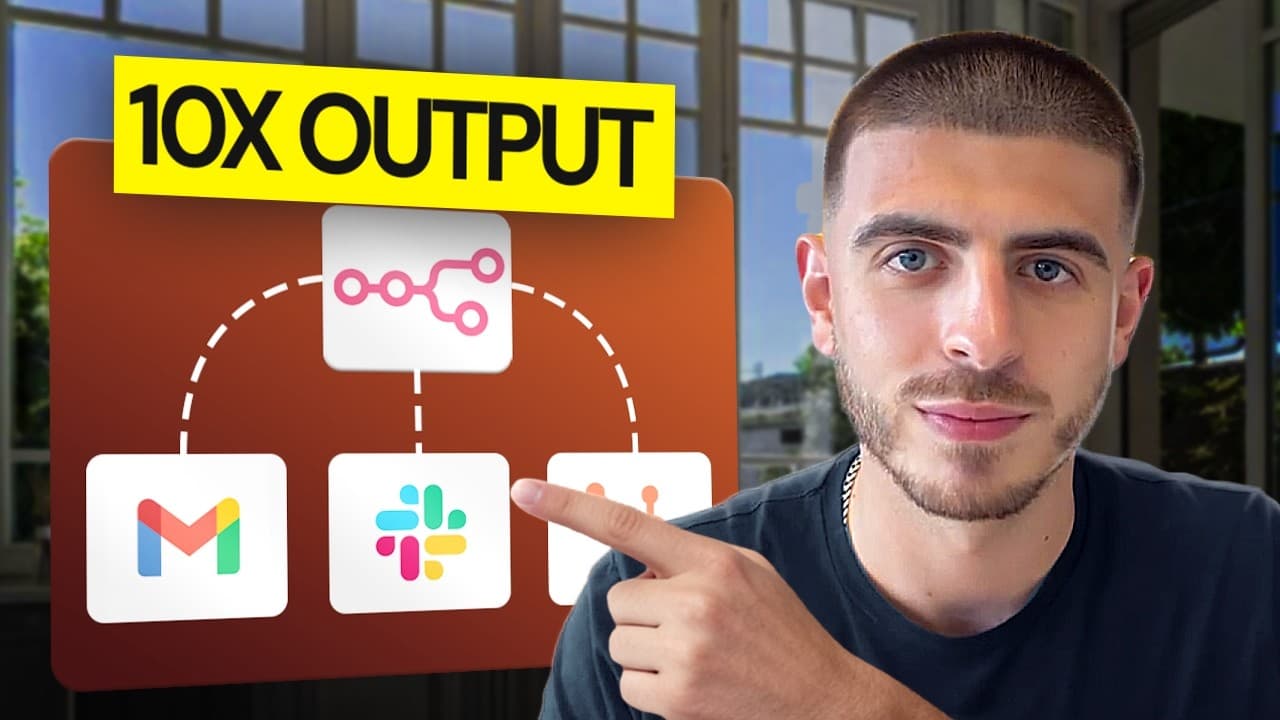
What to Automate First: The 5-Question Test We Run Before Touching a Workflow
Most businesses automate whatever felt annoying that week, and end up speeding up a mess. Before we touch a single workflow for a client, we score it on five weighted questions: time saved, revenue impact, error and quality risk, how repetitive it is, and how feasible it is to build. That gives a score out of 85 and a simple traffic light: 70 or more, automate now; 40 to 69, plan it; under 40, leave it. One reporting task scored 77 and handed my agency back eight billable hours a month.
Read more
The £110k Hiding in Your Own Data: a Live AI Opportunity Audit in Recruitment
We sat down with a freight-forwarding recruitment firm and ran a live AI audit on the data they already owned: their LinkedIn network, their inbox, and a CRM full of candidates nobody had spoken to in over a year. Running that data through AI surfaced £110k of dormant pipeline they'd forgotten about, and showed that 30 to 40% of the team's week was going on admin a machine could do. The lesson for any service business is simple: the cheapest growth you have isn't a new lead, it's the data sitting idle in the tools you already pay for.
Read more
The AI Toolkit: Which AI Tools to Use in Your Business, and When
Stop asking which AI tool is best and start asking which tool for which job. An AI tool is a tool (brilliant at some things, useless at others), so you hire it for a defined job rather than collecting subscriptions. Sort every tool into six buckets (everyday AI, search and synthesis, a creative studio, autonomous agents, smart assets, and automation), hold one per bucket, and you've covered most of what a business does day to day.
Read more